
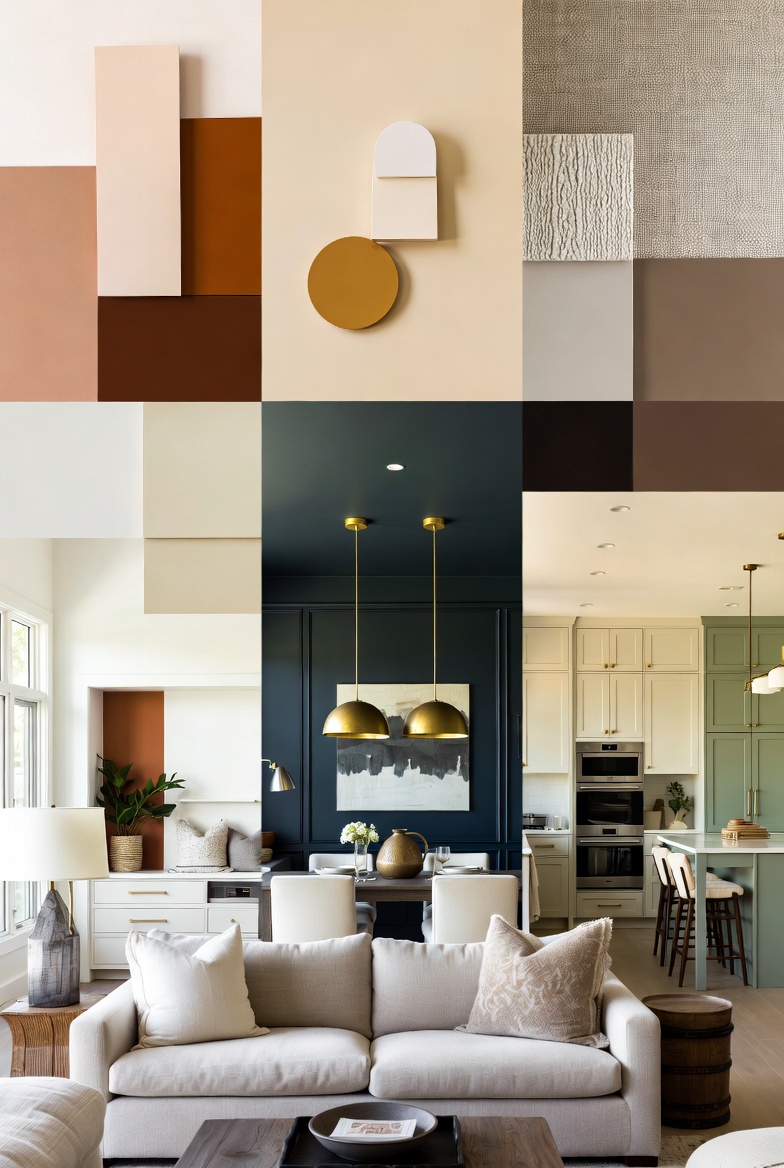
Choosing among color palette ideas for home interiors is easier when the decision starts with the room—not a trend photo. Daylight direction, flooring, countertops, and the bulbs used at night can all change how paint appears. The seven palettes below are practical starting points, with the room conditions, risks, and sample colors needed to test each one properly.
Important: paint names are examples, not guarantees. Screens cannot reproduce paint accurately. Test every candidate in the actual room before buying full-size cans.
Color palette ideas for home at a glance
| Palette | Best starting room | Works especially well with | Main risk to test |
|---|---|---|---|
| Warm neutral + clay + black | Living room or open-plan space | Warm wood, beige stone, cream upholstery | A neutral turning pink or muddy beside the floor |
| Sage + cream + natural wood | Bedroom, kitchen, or bathroom | Oak, rattan, linen, aged brass | Sage appearing gray in weak northern light |
| Navy + warm white + brass | Dining room, office, or accent wall | Walnut, cognac leather, warm metals | A dark wall overwhelming a room with little light |
| Terracotta + chalky white + olive | Kitchen, sunroom, or casual living room | Warm tile, woven texture, handmade ceramics | Too many orange undertones competing together |
| Charcoal + warm white + pale wood | Modern living room or bedroom | Graphic art, oak, boucle, black metal | Cool charcoal clashing with warm fixed finishes |
| Dusty blue + soft white + sand | Bedroom, bathroom, or reading corner | Light wood, natural fiber, brushed nickel | Blue becoming icy under cool LED bulbs |
| Deep green + cream + cognac | Library, dining room, or compact bedroom | Dark wood, leather, brass, warm lamps | Losing detail where the room is already dark |
Before choosing: read the room first
Start with the finishes that are expensive or difficult to replace: flooring, tile, countertops, a stone fireplace, and large upholstered furniture. Place paint samples beside those items rather than judging a color on an empty wall. A warm beige floor can make a blue-gray wall look colder; a pink-beige tile can expose a green undertone that was barely visible in the store.
Next, note the room’s light. North-facing rooms in the Northern Hemisphere usually receive cooler, flatter daylight. South-facing rooms tend to receive stronger, warmer light. East-facing rooms change from warm morning light to cooler afternoon shade, while west-facing rooms do the reverse. This is why the same paint can look calm at breakfast and unexpectedly saturated at sunset.
Light Reflectance Value, or LRV, is a useful comparison number: higher values reflect more light and lower values absorb more. It is not a brightness guarantee, but it helps compare two colors under similar conditions. Sherwin-Williams also recommends considering both room orientation and LRV when choosing neutrals. For a dim small room, start by testing lighter options rather than assuming every pale color will work.
1. Warm neutral, clay, and black
This is a flexible whole-home palette for spaces with warm wood floors, cream upholstery, or beige stone. Use a warm neutral for the large background, a muted clay tone in textiles or art, and small amounts of black for definition.
Paint examples worth sampling include Worldly Gray SW 7043, Natural Linen SW 9109, and Creamy SW 7012. These are examples from Sherwin-Williams’ neutral collections, not interchangeable formulas. Put each sample against the floor and the brightest white object in the room. If the wall looks pink, green, or gray beside either one, try a different undertone before changing the accent colors.
Use the palette: roughly 60% warm neutral, 30% wood or upholstery, and 10% clay and black accents. The percentages describe visual area, not a strict shopping list.
2. Sage, cream, and natural wood
Sage works because it behaves almost like a neutral while still bringing color into the room. It suits kitchens, bedrooms, and bathrooms with natural materials. A sample such as Svelte Sage SW 6164 can be paired with a cream such as Creamy SW 7012, then grounded with oak, rattan, or linen.
Sage is particularly sensitive to light. In a dim room it may read grayer than expected; beside red-toned wood it may look greener. Sherwin-Williams advises looking for a lighter green with an LRV around 60 or higher when the goal is to make a small room feel brighter. That is a starting principle, not a promise: the sample still needs to be checked on every wall.
Avoid: buying all green furnishings at once. Keep most large items cream or wood and repeat the sage in two or three places so the room feels coordinated rather than themed.
3. Navy, warm white, and brass
Navy adds depth to a dining room, office, or one well-lit wall. Pairing it with warm white prevents the contrast from becoming harsh, while brass or cognac leather adds warmth. Anchors Aweigh SW 9179 is one navy example to sample; compare it with a softer white such as White Flour SW 7102.
Before painting all four walls, test the navy behind the main furniture and in the darkest corner. If the furniture disappears into the wall, use the navy on millwork or a single focal wall instead. Keep the ceiling and trim consistent unless there is a deliberate color-drenching plan.
Best balance: navy as the focal surface, warm white across the larger area, and metal as a small accent. Brass does not need to appear on every fixture; two or three repeated touches are enough.
4. Terracotta, chalky white, and olive
Terracotta brings warmth to rooms with plenty of daylight and natural texture. Cavern Clay SW 7701 is one clay-colored reference point. Use it with a restrained white, then add olive through plants, fabric, or one painted piece rather than competing green walls.
This palette can become overly orange when paired with honey oak, orange tile, and warm bulbs at the same time. Compare the clay sample with every existing warm finish. If they compete, move terracotta to washable textiles and keep the walls quieter.
Useful application: white walls, a clay-toned banquette or textile, olive cushions, and unglazed pottery. This gives the room the warmth of the palette without requiring a full repaint.
5. Charcoal, warm white, and pale wood
A charcoal-and-white palette creates strong architecture in modern rooms. Iron Ore SW 7069 and Charcoal Blue SW 2739 are two different dark directions to compare; one may sit better with the room’s fixed finishes than the other. Use warm white and pale wood to keep the result from feeling flat.
Dark paint is most effective when the boundaries are intentional. It can frame a fireplace, define built-ins, or create a headboard wall. In a small dim room, painting every surface charcoal can hide corners and reduce contrast between furniture and wall. That can feel cocooning, but it is not the same as making the room look larger.
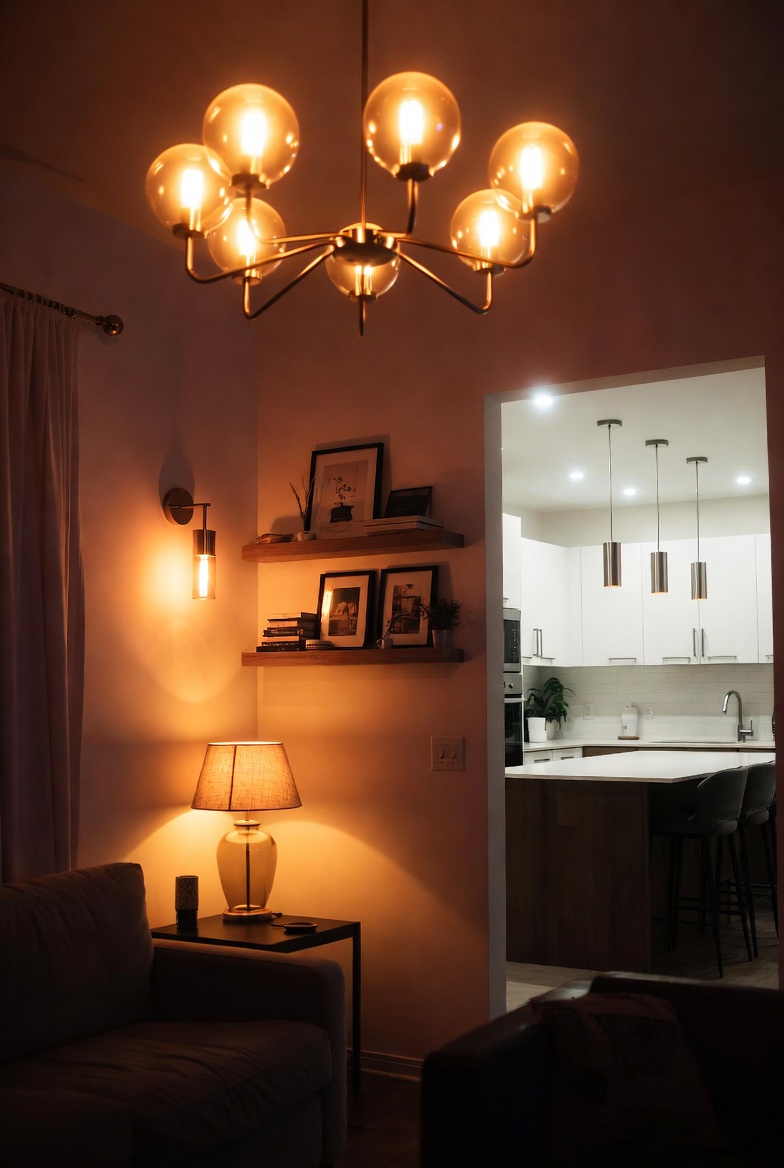
Check at night: cool 5000K bulbs can make charcoal and white feel stark. A warmer 2700K–3000K lamp usually produces a softer residential effect, but bulb color should be selected for the tasks performed in the room.
6. Dusty blue, soft white, and sand
Muted blue is a calm choice for a bedroom or bathroom when it is supported by warm materials. Sea Salt SW 6204 is a familiar blue-green example; test it beside a cleaner pale blue and a neutral before deciding which direction the room needs.
In a north-facing room, blue can intensify. Bring warmth back through sand-colored fabric, light wood, or a creamier white—not by adding several unrelated accent colors. In a bright west-facing room, recheck the sample during late-afternoon sun, when it may become more saturated.
Keep contrast readable: very pale blue walls and white trim can merge. Use a noticeable value difference or simplify by painting wall and trim the same color in different appropriate finishes.
7. Deep green, cream, and cognac
Deep green works well in libraries, dining rooms, and bedrooms designed to feel enclosed and restful. Pair it with cream to protect readability and with cognac leather or dark wood for warmth. Sherwin-Williams’ green collection includes options such as Pewter Green SW 6208 and Evergreen Fog SW 9130; sample more than one depth before committing.
Use the darkest green where the room can support it: around shelving, on a feature wall, or throughout a space with several warm light sources. If faces, artwork, and furniture lose definition at night, improve layered lighting before adding more dark paint.
Avoid: treating brass as the only light source. Use ambient, task, and accent lighting so the room remains functional after sunset.
A reliable paint-sampling method
- Choose three candidates, not one. Include a lighter, a darker, and a slightly different undertone.
- Use a large sample. Benjamin Moore recommends testing on the wall or on movable white foam board; its brush-on sample guidance covers roughly a 2-by-2-foot area.
- Move the sample. Check beside flooring, trim, upholstery, and the darkest corner rather than leaving it in one bright spot.
- Observe it for a full day. Review morning, afternoon, and night under the bulbs that will actually be used.
- Compare sheen separately. A sample shows color, but the final paint’s sheen and surface texture can alter perception.
- Record the decision. Save the brand, color name, code, product line, and finish so later touch-ups do not depend on memory.
For official sampling guidance, see Benjamin Moore’s paint-sample guide. For more on room orientation and LRV, see Sherwin-Williams’ neutral-color guidance.
How to connect the palette to the rest of the room
Paint is only one layer. Use the dominant wall color as a background, repeat the secondary color in two or three medium-size elements, and reserve the accent for objects that are easy to change. If art is the next decision, compare the palette with these DIY wall art ideas for a living room. A monochrome direction is easier to visualize in this black-and-white living room guide, while a soft green kitchen is explored in the DIY kitchen backsplash guide.
Frequently asked questions
Should every room use the same palette?
No. Connected rooms benefit from a shared undertone or repeated neutral, but each room can shift the balance. Repeating one trim color, wood tone, or accent is often enough to create continuity.
Does a dark color always make a room look smaller?
Not always. Dark colors can soften corners and create depth, but they also absorb more light. The result depends on windows, artificial lighting, contrast, and how the room is used. Test the color rather than relying on a universal rule.
What is the safest palette for resale?
A warm or balanced neutral background with natural materials is broadly adaptable, but there is no single resale color for every house. Flooring, trim, regional light, and the condition of the paint matter more than following one popular shade.
Can warm and cool colors be mixed?
Yes. A room often feels more natural when it contains both, provided one temperature leads and the other supports it. A cool blue wall can work with warm wood; a warm neutral can work with black metal. Problems arise when several competing undertones appear in equal amounts.
Choose with evidence, not the screen
The best home color palette is the one that works with the room’s fixed finishes, daylight, and evening lighting. Start with the constraints, narrow the choice to three samples, and observe them before buying paint. That slower first step is much faster—and less expensive—than repainting a room chosen from a phone image.
[…] the room needs a broader palette before selecting art, use the Housify home color-palette guide. For a warmer handmade look, compare these ideas with the boho living-room wall decor guide. A […]